
We’ve just wrapped up WUD Bolzano 2026, which we organised together with unibz. We’re still recovering and already itching to publish the proceedings, with all the transcriptions of the talks. If you’re interested, follow WUD Bolzano on Instagram: you’ll find out when they’re out and, in the meantime, see a few photos of the day. It was one of those days when you manage to get researchers, designers and content creators in the same room to talk about something rather unwieldy. This year the international organisers gave us Designing a Sustainable Future with Ethical AI.
In the opening talk, we took the liberty of looking a little more closely at the title. It’s a fair number of buzzwords for one sentence. Sustainable would deserve a talk of its own, given how much energy and water these systems use. And then there’s Ethical AI, which is an oxymoron. We took the theme with a pinch of salt and ended up with one of our own: Hallucination interpretation. This is how we got there.
Ethics is a slippery word all on its own. In the abstract, we more or less know what we mean. Then we look around. Of all the stuff we eat, wear and use every day, how much of it can we call a hundred per cent ethical?
Take coffee. I love it. I drink quite a lot of it. I know there can be exploitative labour, economic inequalities and environmental costs behind a cup. I keep drinking it anyway. At some point I negotiated with myself and came to a compromise I could live with. That I is doing quite a bit of work, especially when someone else is picking up part of the bill.
We make these compromises all the time. Imagine going back through the data on the coffee supply chain every time you order one. Then looking up the T-shirt you’re wearing. Then the phone you’re using to pay. By now the coffee’s gone cold.
With many of these things, though, there’s somewhere to start if we want to know more. Someone has traced parts of the supply chain, collected data, documented working conditions. And we know the limits of plenty of the things we use, even if we’ve learnt them through experience. All of that helps us decide whether something is worth using. Sometimes it even makes us change our minds.
With generative AI, it’s harder to know what we’re saying yes to. We know something about its impacts. What we don’t know is what’s inside. We open a chat or ask for an image, and even after months of doing it, we may still know very little. What data was the model trained on? How was it collected? When is the model likely to get things wrong? AI is opaque by design, but sometimes it gives itself away.
Count the fingers
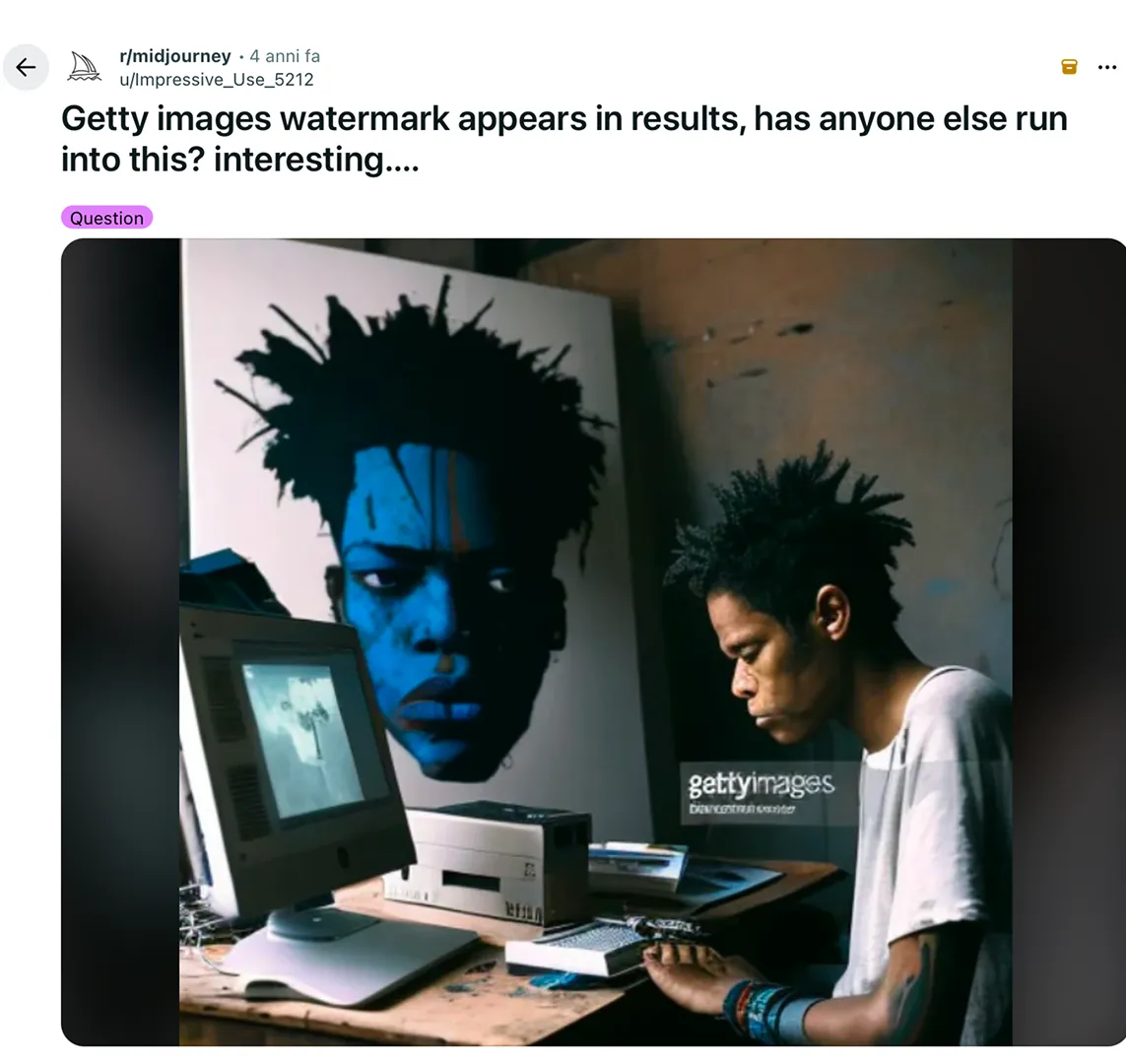
It’s from 2022, which is ancient history for an AI-generated image. There are the usual improbable hands. And there’s something that looks like a Getty Images watermark. It’s wonky, but you can tell exactly what it’s meant to be.
It’s tempting to call these errors, even though the model was doing exactly what it was built to do. It was generating an image from patterns it had learnt from other images. As far as the model was concerned, the watermark was as much a part of the picture as a sleeve or a shadow. And to put together a hand, all it needed was something that looked roughly like one. Sometimes, apparently, there was room for an extra finger.
That wonky watermark gives us a clue about the images the model learnt from. It’s hard to look at it without wondering how they got in there, who made them and who said they could be used. The hands show us something else. The image looks perfectly plausible. Then you count the fingers.
You see images like this less often now. Some things come out better. Others get corrected or filtered before they reach us. The seams are still there. They’re just getting harder to spot. And when a hand looks like a hand, who bothers to count the fingers?
Hallucination interpretation
They’re called hallucinations. It’s a funny word. It makes it sound as if someone on the other end is briefly seeing something that isn’t there.
Maybe these are the most honest moments we have with AI. For a second, we get a glimpse of how the system is put together. That watermark and that extra finger are a bit like the screws on something you want to take apart. You might open it up and still have no idea what you’re looking at, but at least you have somewhere to start. It’s worth looking for these hallucinations while we can still see them, and trying to work out what they show us.
That’s where our theme came from. If hallucinations are where the system shows its seams, then interpreting them is a design job: making complex systems readable is what design is supposed to do. Hallucination interpretation was our way of taking Designing a Sustainable Future with Ethical AI with a pinch of salt.
So here’s a question for World Usability Day. If we’re so good at designing things that are easy to use, can we design a few that are easy to take apart, too? It might help us see what compromises we’re saying yes to before we get used to making them.
That’s how we opened WUD. We were happy to find the same pinch of salt, and the same critical eye, in all the talks that followed. We can’t wait to hallucinate together again over the proceedings!
Follow us on
Instagram
LinkedIn
Spotify