

Every year, for one week, Milan becomes the world capital of design. Designers, students, brands, influencers, and people whose jobs remain a mystery descend on the city to admire chairs, photograph chairs, and occasionally sit on chairs.
It's Milan Design Week, one of the industry's biggest events. An excellent opportunity to meet people, discover ideas, and drink free prosecco in showrooms that wouldn't let you through the door on a normal Tuesday.
There's just one tiny issue: you have to afford being there.
Milan isn't exactly cheap the rest of the year, either. But during Design Week, accommodation prices seem to become an experimental design discipline of their own. For many students, attending one of the most important events in their field is a luxury.
And the event isn't entirely separate from the problem. Research by OffTopic Lab explores the relationship between short-term rentals and Design Week, including how temporary demand can have effects beyond the event itself. So the city isn't simply expensive despite the design spectacle. The spectacle is part of a much bigger urban economy.
Luckily, we have design.
And design, as we're constantly reminded, solves problems.
From protest to project
In 2023, a student at the Polytechnic University of Milan pitched a tent outside the university to protest unaffordable rents. Other students joined in, and the protest spread across Italy. The message wasn't particularly difficult to decode: we can't afford to live in the cities where we study.
The tent was a symbol of a housing problem.
A deliberately uncomfortable one.

In 2024, IED and Fondazione Francesco Morelli launched The Glitch Camp, offering design students free camping accommodation during Milan Design Week, with support from commercial partners.
And, to be clear, that's useful. Students who might otherwise have been priced out of the event get a place to stay. Real people benefit. That's not nothing.
Still, the contrast is hard to miss.
In 2023, sleeping in a tent was a way to protest a problem.
In 2024, sleeping in a tent became a design response to a problem.
The problem hadn't gone anywhere.
But now there was a project name, a visual identity, a programme of activities, and sponsors. A significant upgrade, at least from a branding perspective.
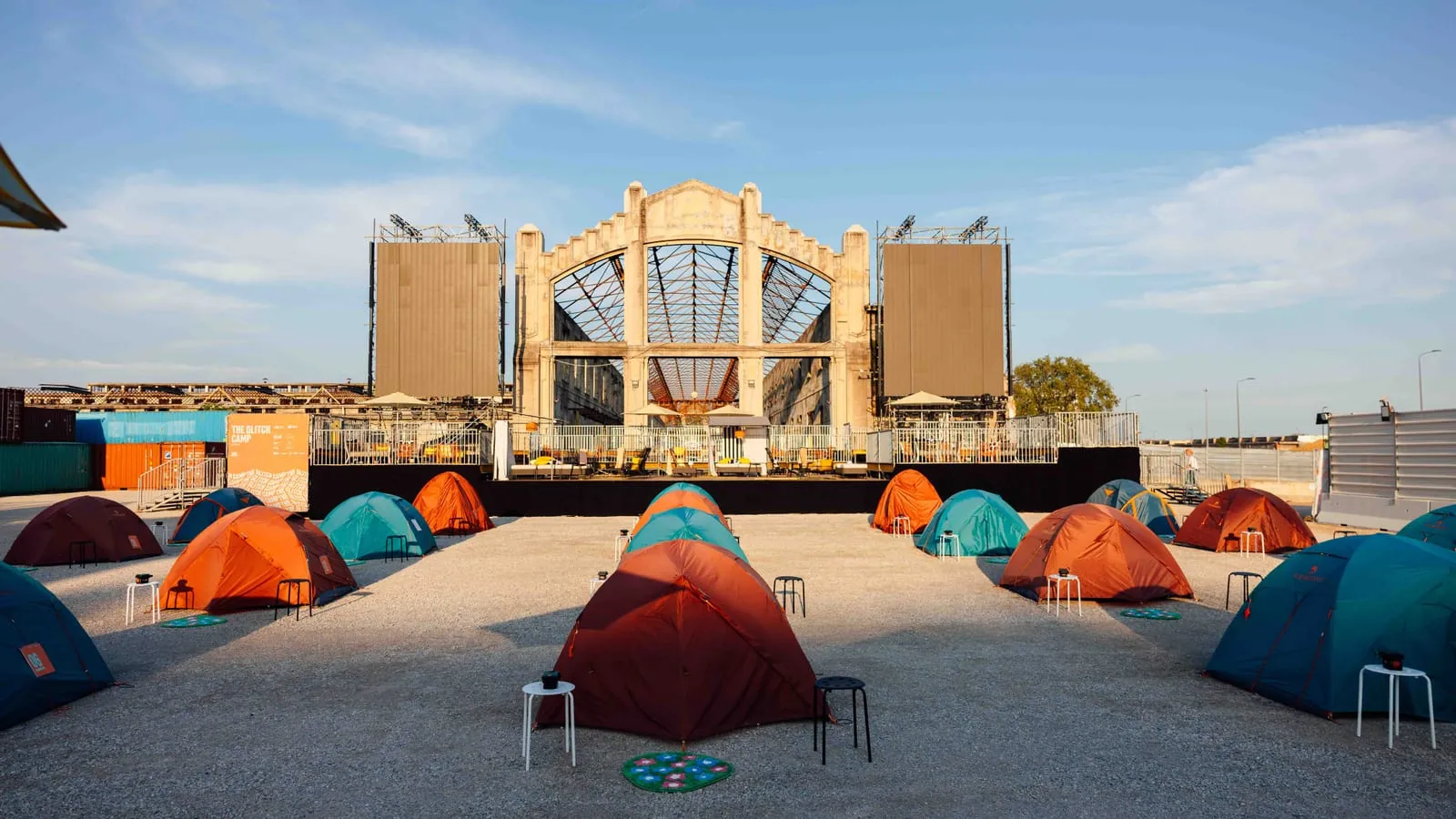
And the design award goes to…
In 2026, The Glitch Camp received a Compasso d'Oro, one of Italy's most prestigious design awards, for its social dimension.
This is where the story gets almost too neatly written. A campsite created because students can't afford accommodation during a major design event becomes an example of award-winning social design.
Again: the campsite isn't the villain here. Making an exclusionary event more accessible is a good thing. But an award doesn't just recognise a useful service. It also helps define what the industry considers exemplary design.
So what, exactly, are we celebrating? A temporary way around an economic barrier? The ability to make an expensive event more inclusive without changing what makes it expensive? Or a meaningful intervention into the conditions that create the barrier in the first place?
Those aren't the same thing.
And maybe the problem isn't the project. Maybe it's how enthusiastically the design industry applauds itself for making its own contradictions slightly more comfortable.
Social design, now with better amenities
We talk a lot about social design, inclusion, sustainability, and innovation. We teach these ideas, put them in presentations, and sprinkle them across project descriptions with impressive confidence.
And here's a lovely little detail: IED also offers a Master's in Social Ecological Design, where students explore alternative economies, power structures, and the role of design in questioning dominant market logics.
Which sounds great. We genuinely mean that.
It's just interesting that an institution teaching designers to question the systems behind social problems is also being celebrated for helping people temporarily navigate one of those problems.
Perhaps the next workshop could explore that.
Are we designing to change the conditions that create a problem, or to make living with that problem a little nicer?
Both can be worthwhile. A temporary fix can matter enormously to the person who needs it. But treating the fix as the pinnacle of social innovation should at least make us mildly uncomfortable.
Especially when the broader context involves a city reshaped by real-estate pressures, short-term rentals, and the event economy. For more on that, Lucia Tozzi's essay in Domus is worth reading.
Design can't single-handedly fix Milan's housing crisis. We wouldn't ask it to. That sounds like the premise of a three-day workshop involving 400 sticky notes and no actual housing.
But design can decide which questions are worth asking. And awards can decide which answers deserve applause.
Yes, we're part of it too
At this point, we could explain what real social design should look like, preferably alongside a solemn black-and-white portrait of our studio.
That would be unbearable.
We work within the same industry. We have clients, budgets, compromises, and bills. And, to make the contradiction more entertaining, our own project Sete was selected for the ADI Design Index, putting it on the path towards the Compasso d'Oro.
So yes, we're questioning an award system we'd also be quite pleased to receive recognition from.
The irony isn't lost on us.
We're not claiming moral superiority. We'd just like to believe design can do more than package the symptoms of a problem into a pleasant, sponsor-friendly experience.
If students can't afford a room, offering them a tent is a helpful gesture. But when the tent becomes an emblem of outstanding social design, maybe the industry should ask itself a few more questions.
Or maybe we're missing the point. Either way, we'll bring a sleeping bag next year.
Follow us on
Instagram
LinkedIn
Spotify